
AI Workflow Automation: Benefits, Challenges, and Future Trends
Introduction
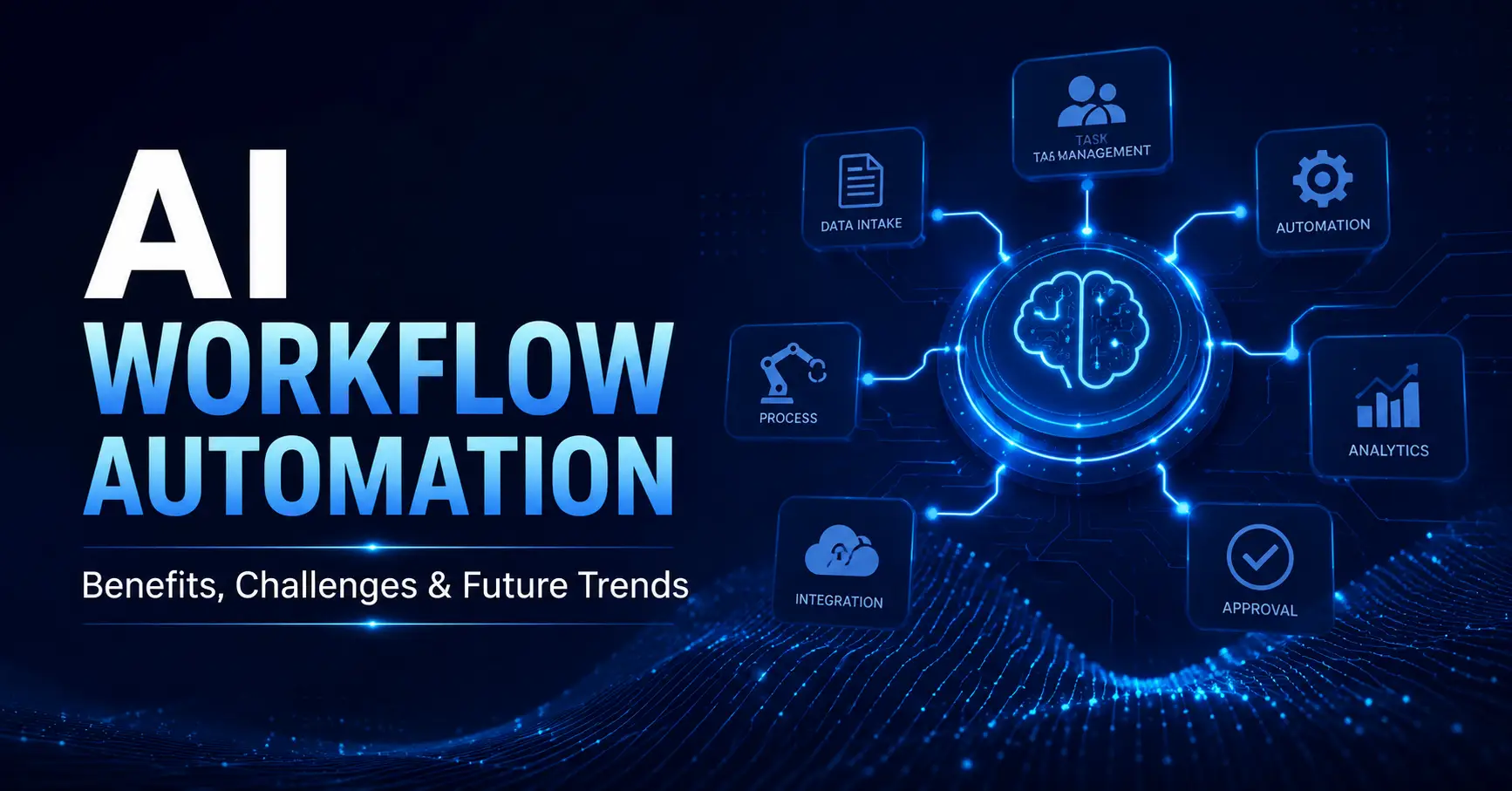
AI workflow automation is reshaping how modern enterprises operate, compete, and grow. In 2026, businesses that rely on manual, disconnected processes are falling behind competitors who have embedded intelligence directly into their operations.
According to McKinsey Global Institute, automation technologies could enable companies to automate up to 70% of work activities currently performed by humans. That is not a distant prediction — it is happening right now across finance, healthcare, SaaS, logistics, and beyond.
This guide covers everything decision-makers need to know about AI workflow automation: a clear definition, the business case for adoption, key benefits, real-world use cases, implementation challenges, emerging trends, and a set of proven best practices. Whether you are an IT manager, a founder scaling a SaaS platform, or a digital transformation consultant, this article delivers the strategic clarity you need to act with confidence.
What Is AI Workflow Automation?
AI workflow automation is the application of artificial intelligence — including machine learning, natural language processing (NLP), and computer vision — to automatically design, execute, monitor, and optimize business processes across an organization’s technology ecosystem.
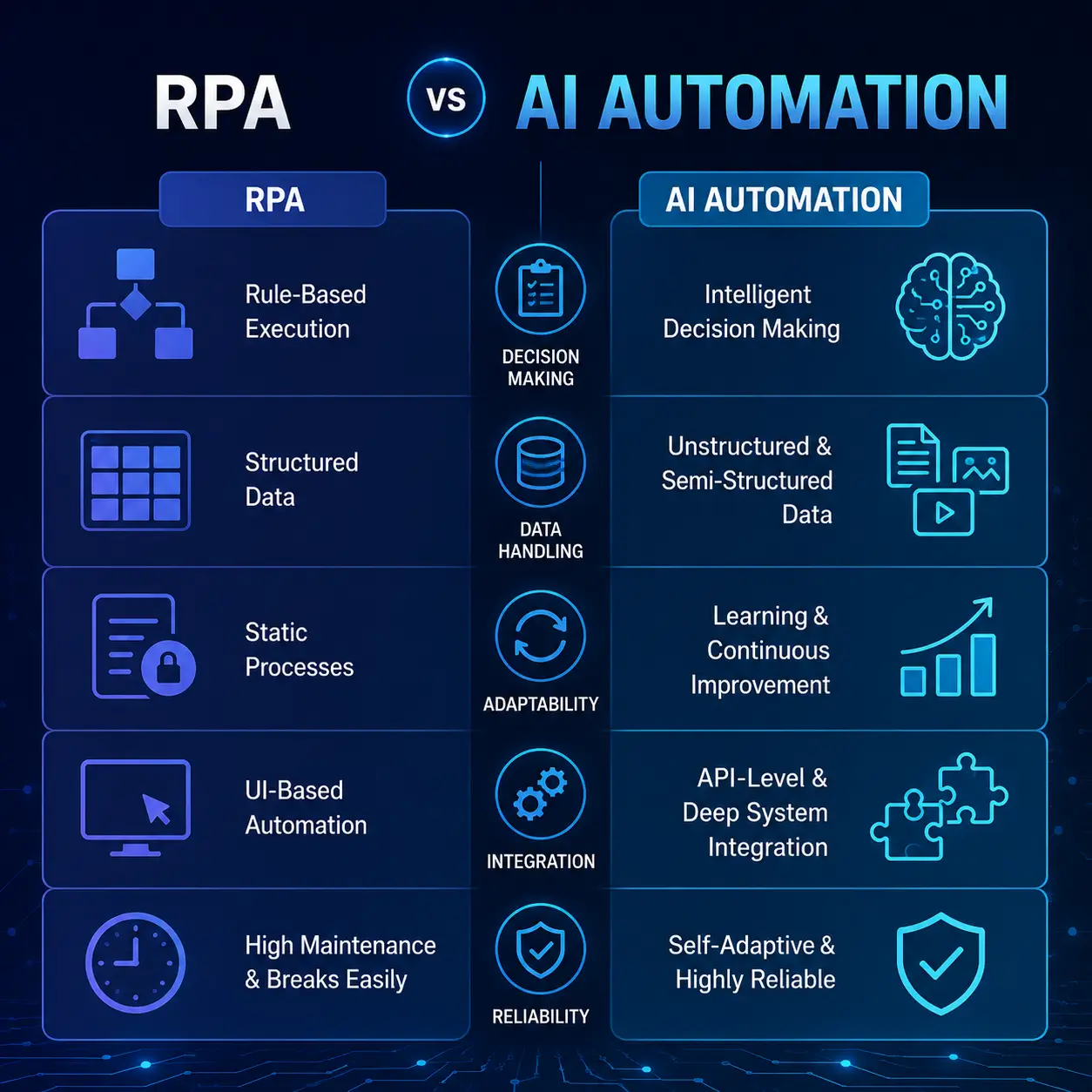
It goes significantly beyond traditional rule-based Robotic Process Automation (RPA). While RPA follows rigid, predefined scripts, AI-powered workflow automation:
- Learns and adapts from historical data and real-time inputs
- Handles unstructured content — emails, PDFs, voice recordings, scanned documents
- Makes contextual, probabilistic decisions without human programming
- Integrates natively with cloud platforms, SaaS tools, and enterprise APIs
- Continuously improves its own performance through feedback loops
In practical terms, AI workflow automation replaces fragmented, manual handoffs between teams and systems with a unified, intelligent orchestration layer that works 24/7 — accurately, at scale, and without fatigue.
Why Businesses Need AI Workflow Automation in 2026
The urgency around intelligent process automation has reached a tipping point. Four converging forces are making adoption a strategic imperative — not an optional upgrade.
Rising Operational Costs
Manual processes are expensive at scale. Research shows that knowledge workers spend approximately 40% of their time on repetitive, low-value tasks. That is nearly half of your payroll delivering negligible strategic output.
Exploding Data Volumes
Enterprise data volumes are growing at 30–40% annually. No human team can process, classify, and act on that volume in real time. AI automation bridges the gap — ingesting, enriching, and routing data across cloud systems instantly.
Elevated Customer Expectations
Modern customers expect sub-minute response times, hyper-personalized experiences, and zero-friction digital interactions. Meeting these expectations at scale requires AI-powered automation across customer service, marketing, and fulfillment workflows.
Accelerating Competitive Pressure
Companies deploying intelligent workflow automation are compressing time-to-market, reducing service delivery costs, and scaling faster. For businesses still operating manually, the gap is widening every quarter.
Key Benefits of AI Workflow Automation
Enterprises that strategically implement AI workflow automation consistently report measurable gains across operations, finance, and talent. Here are the most impactful benefits, backed by industry evidence:
1. Dramatic Efficiency Gains
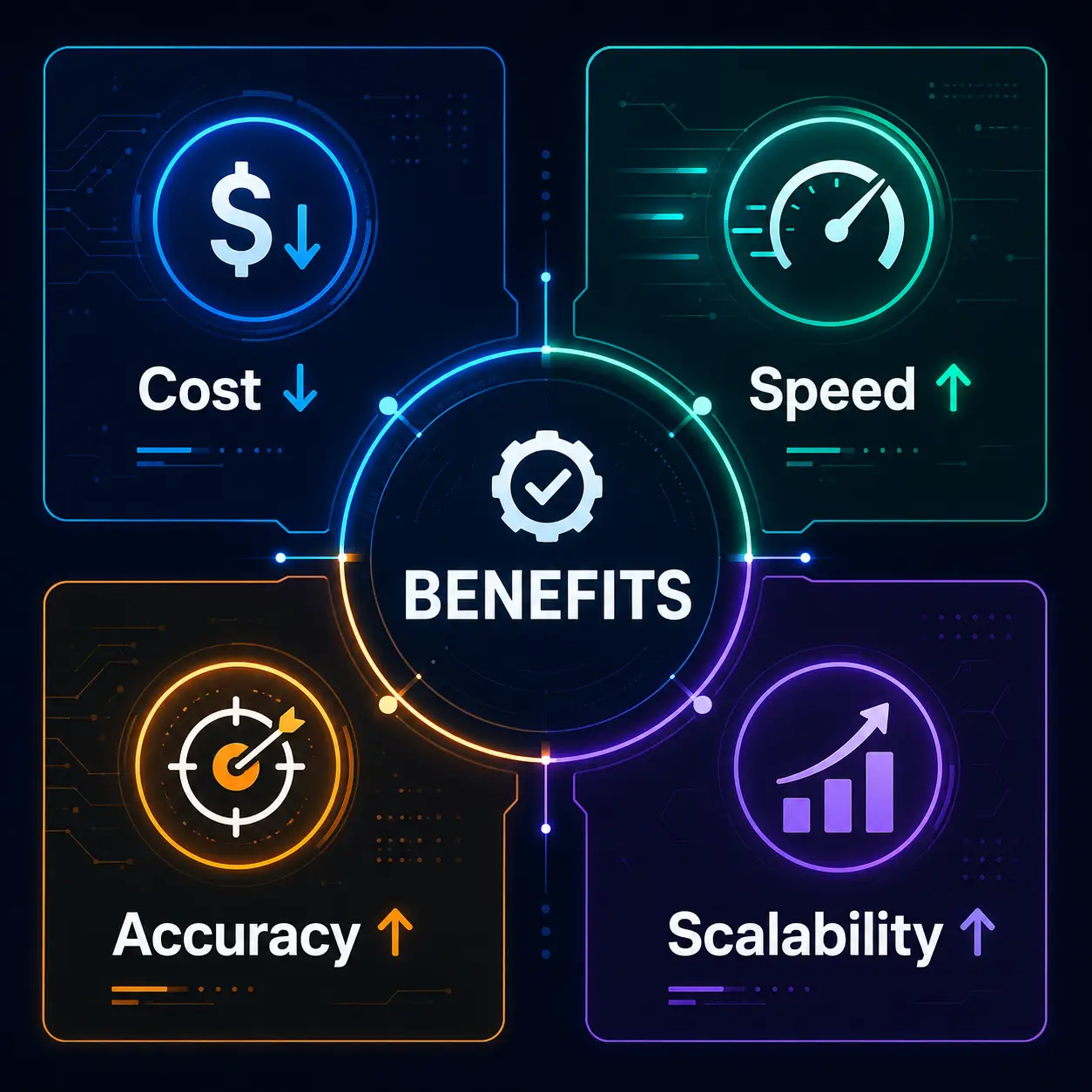
Automated workflows execute tasks in milliseconds. Processes that take human teams hours — invoice matching, lead routing, compliance checks — complete instantly. Organizations routinely report 60–80% reductions in process cycle times after deployment.
2. Significant Cost Reduction
AI automation reduces dependency on manual labor for routine operations. Industry benchmarks show 30–70% cost savings in automated process areas. These savings compound over time as systems optimize themselves without additional investment.
3. Substantially Higher Accuracy
Human error rates in data-intensive tasks — entry, classification, validation — can reach 4–5%. AI automation systems, once properly trained, maintain sub-0.1% error rates consistently. In finance, compliance, and healthcare, this precision is non-negotiable.
4. Unlimited Scalability
Cloud-native automation infrastructure scales elastically with demand. Whether you process 500 or 5 million transactions per month, the system adapts without proportional headcount increases. This is a game-changer for fast-growing SaaS businesses.
5. Real-Time Business Intelligence
Every automated workflow generates structured process data continuously. Fed into analytics platforms, this creates live visibility into operational performance, bottlenecks, and optimization opportunities — enabling data-driven decision-making at every organizational level.
6. Improved Employee Engagement
When automation absorbs repetitive, low-value tasks, employees redirect their energy to creative, strategic, and relational work. This shift measurably improves job satisfaction and reduces turnover — a significant benefit in today’s competitive talent market.
7. Automated Compliance and Audit Readiness
Regulated industries gain automated audit trails, consistent process execution, and real-time compliance monitoring. Documentation that once required manual assembly now generates automatically — reducing regulatory risk and audit preparation time by up to 75%.
Real-World Use Cases of AI Workflow Automation
The following use cases represent active, production-grade deployments across major industries. Each demonstrates measurable ROI from AI-powered business process automation.
Finance and Accounts Payable
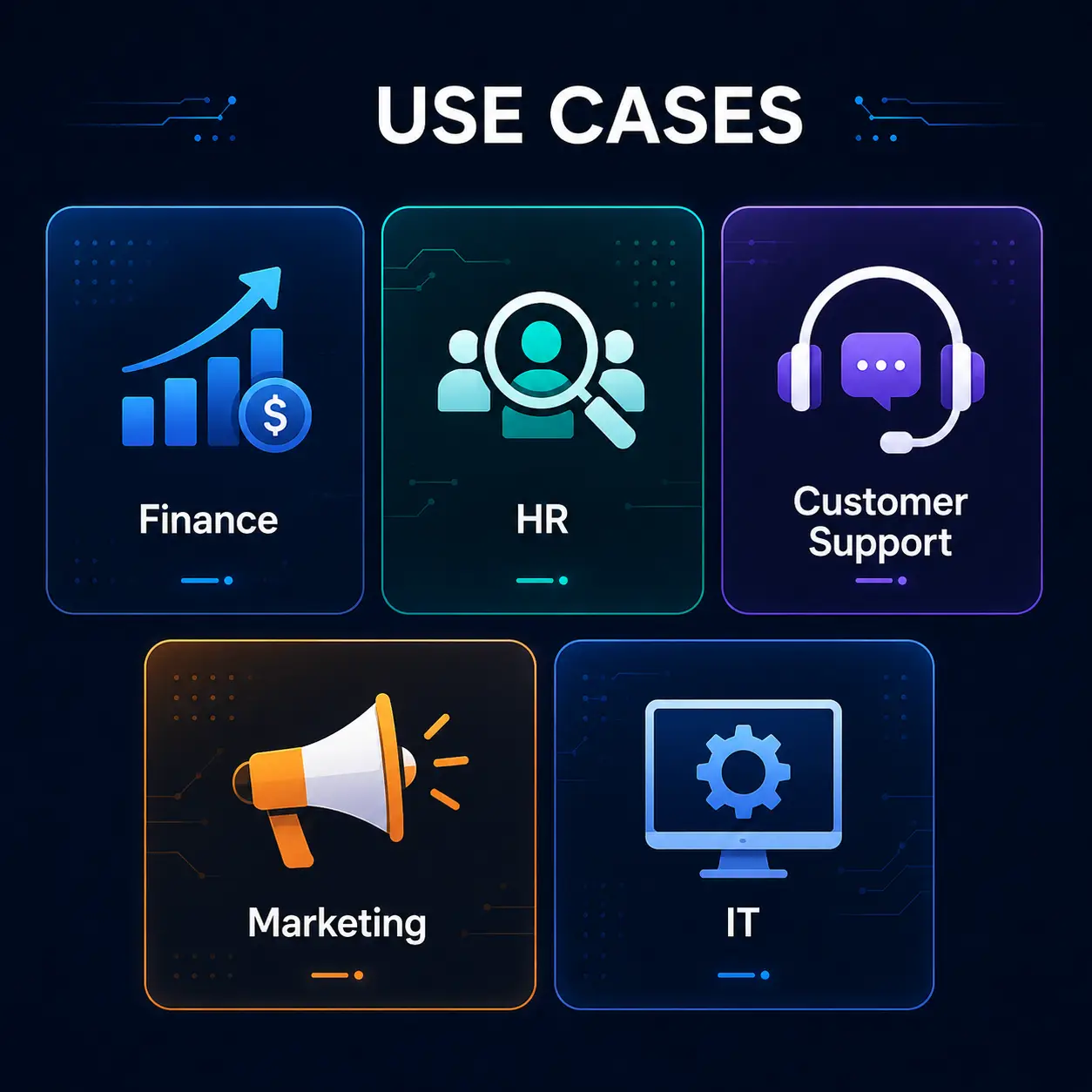
AI automation extracts invoice data from PDFs and emails using NLP and OCR, matches purchase orders automatically, flags discrepancies for human review, and routes approved invoices to payment — reducing processing time from 5 days to under 2 hours and cutting error rates by over 80%.
Human Resources and Talent Acquisition
AI-powered HR platforms screen thousands of resumes in seconds, rank candidates by fit score, schedule interviews via calendar integrations, deliver personalized onboarding documentation, and trigger automated compliance training workflows — enabling HR teams to scale hiring 4x without additional recruiters.
Customer Service and Support
Intelligent virtual agents handle Tier-1 support automatically via natural language understanding. Complex cases escalate to human agents with full context pre-populated. Resolution summaries generate and sync to CRM systems automatically. Result: 60% of inquiries resolved without human intervention, 24/7.
Sales Operations and CRM Hygiene
Sales workflows from lead capture to closed deal run on automation. AI enriches contacts, scores leads by conversion probability using behavioral signals, sends personalized follow-up sequences, and syncs CRM data in real time — eliminating manual data entry and keeping pipelines accurate.
IT Operations and Incident Management
AI continuously monitors infrastructure health, correlates alerts across systems, automatically remediates known issues (server restarts, cache clears, resource scaling), and escalates novel incidents with full diagnostic context. Mean time to resolution drops by 50–70%.
Supply Chain and Inventory Management
Automated workflows monitor inventory levels in real time, trigger purchase orders at optimal reorder points, reroute logistics around disruptions detected via external data feeds, and reconcile supplier invoices automatically — eliminating manual touchpoints across the supply chain.
Marketing Campaign Operations
Marketing automation handles campaign scheduling, audience segmentation, A/B test creation and monitoring, lead nurturing sequences, and performance reporting — all autonomously. AI optimizes messaging and timing based on engagement data, improving campaign ROI by 20–40%.
Future Trends in AI Workflow Automation
The next evolution of AI workflow automation is already emerging in enterprise technology roadmaps. These are the trends that will define intelligent automation through 2027 and beyond.
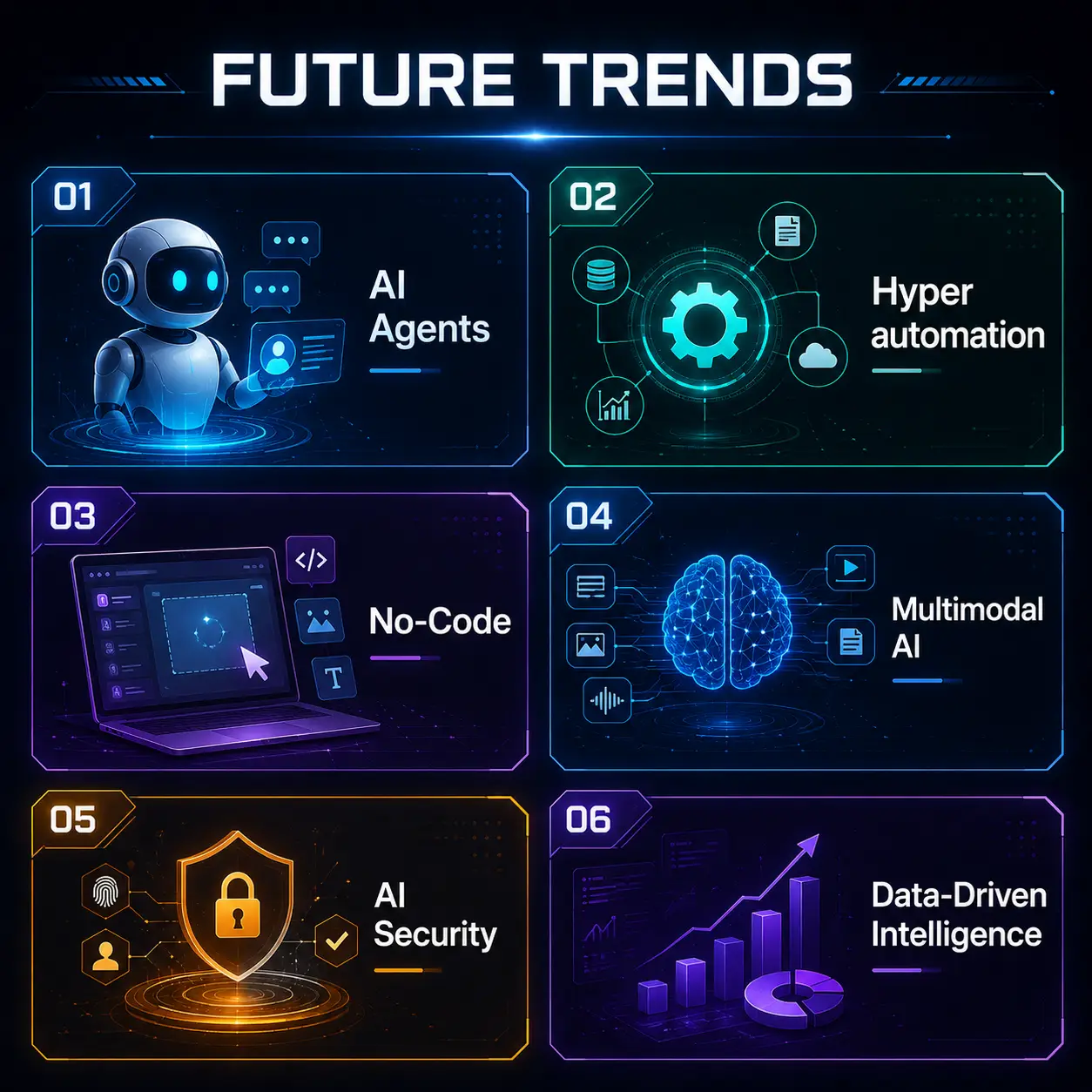
1. Agentic AI and Autonomous Workflow Orchestration
AI agents — autonomous systems capable of goal-directed planning, reasoning, and multi-step task execution — are the most significant development in enterprise automation since cloud computing. Unlike static workflow triggers, AI agents dynamically determine the best sequence of actions to achieve a defined objective. Enterprises will increasingly deploy specialized agent fleets managing procurement, software development, customer success, and financial operations.
Learn more: OpenAI Research on Agentic Systems
2. Multimodal Automation
Future automation systems process text, images, audio, video, and structured data simultaneously. A single workflow can read a scanned contract via computer vision, extract key clauses via NLP, match terms against a database, flag anomalies, and trigger approval routing — in one fully automated sequence requiring zero human input.
3. Hyperautomation at Enterprise Scale
Hyperautomation — the systematic identification and automation of every automatable business process — has moved from Gartner’s emerging technology list to C-suite strategic priority. According to Gartner, hyperautomation is a key technology trend through 2026, with organizations combining RPA, AI, process mining, and advanced analytics into unified automation platforms.
4. Low-Code and No-Code Automation Democratization
Business users — without engineering skills — are building and modifying complex workflows using drag-and-drop, natural language prompting, and AI-assisted design tools. This democratization compresses automation deployment cycles from months to days and puts workflow intelligence directly in the hands of domain experts.
5. AI-Native Process Mining
Process mining technology, enhanced by generative AI, automatically discovers current-state workflows from system event logs, identifies inefficiencies and automation opportunities, and generates prioritized recommendations — eliminating guesswork from automation strategy and enabling continuous improvement cycles.
6. Self-Healing Workflow Infrastructure
Next-generation automation platforms proactively predict integration failures, automatically reroute workflows around broken API connections, and self-repair process logic when upstream system changes break existing automations — dramatically reducing operational overhead for IT and DevOps teams.
7. Responsible AI and Explainable Automation
As AI systems handle more consequential decisions — credit approvals, medical triage routing, legal contract review — explainability, bias monitoring, and auditability are becoming regulatory and ethical requirements. Organizations will invest heavily in governance frameworks ensuring every automated decision can be traced, explained, and challenged.
Best Practices for Implementing AI Workflow Automation
Successful automation programs share a consistent set of principles. Apply these to maximize ROI and minimize implementation risk:
-
Start with process mapping, not tools.
Document current-state workflows in detail before selecting any platform. Use process mining tools to surface hidden inefficiencies. Automating a broken process only produces broken automation faster — and at greater cost. -
Target high-volume, rule-clear processes first.
Initial deployments should focus on processes with consistent logic, high transaction volume, and clear success metrics. These deliver rapid ROI and build organizational confidence before tackling complex, judgment-heavy workflows. -
Establish data quality as a prerequisite.
AI automation is only as accurate as its training data. Implement data governance, cleansing, and MDM programs before deployment. Validate data pipelines rigorously before going live. -
Define clear, measurable success metrics upfront.
Establish KPIs before deployment: cycle time reduction targets, error rate thresholds, cost-per-transaction benchmarks, employee hours recovered. What gets measured, gets optimized. -
Build composable, modular automation architecture.
Design workflows as reusable building blocks rather than monolithic scripts. Modular architecture accelerates future deployments, simplifies maintenance, and reduces technical debt. -
Establish an Automation Center of Excellence (CoE).
Create a dedicated cross-functional team responsible for automation governance, standards, training, reusable component libraries, and scaling decisions. A CoE prevents redundant efforts and ensures quality at enterprise scale. -
Integrate with your analytics and BI stack from day one.
Connect automated workflows to business intelligence platforms so process performance data flows into dashboards in real time. Automation without visibility is automation without accountability. -
Plan for continuous model monitoring and retraining.
Business conditions evolve. Schedule regular AI model review cycles with automated drift detection alerts. Treat your automation stack as a living system that requires ongoing investment — not a one-time project. -
Embed security and compliance controls at design time.
Include security architects and compliance officers in automation design reviews. Automate access controls, data masking, audit logging, and anomaly detection — do not bolt them on afterward. -
Communicate change proactively to your workforce.
Transparent communication about automation goals, timelines, and implications reduces resistance dramatically. Frame automation as workforce augmentation and back it with visible reskilling investment.

Frequently Asked Questions About AI Workflow Automation
1. What is AI workflow automation?
AI workflow automation is the use of artificial intelligence and machine learning to automatically design, execute, manage, and optimize business processes across an organization’s systems and applications. Unlike traditional rule-based RPA, AI-powered automation handles unstructured data, learns from experience, and makes contextual decisions without human programming — enabling end-to-end process intelligence at enterprise scale.
2. What are the top benefits of AI workflow automation for businesses?
The primary benefits include 30–70% reductions in process costs, 60–80% faster process cycle times, dramatically higher data accuracy, unlimited cloud-native scalability, real-time business intelligence from process data, improved employee engagement, and automated compliance documentation. These benefits compound over time as AI systems continuously optimize their own performance.
3. How is AI workflow automation different from traditional RPA?
Traditional RPA follows fixed, rule-based scripts on structured data and breaks when UI elements change. AI workflow automation uses machine learning to handle unstructured inputs (documents, emails, images), make contextual decisions, adapt to changing conditions, and self-improve over time. AI automation is deeper, more resilient, and significantly more capable than traditional RPA across complex enterprise processes.
4. Which industries benefit most from AI workflow automation?
Finance and banking, healthcare, retail and e-commerce, manufacturing and logistics, human resources, IT operations, and SaaS companies all see strong ROI from AI workflow automation. Any sector with high-volume, repeatable processes involving data classification, customer interaction, compliance reporting, or system integration benefits significantly from intelligent automation.
5. What should enterprises consider before implementing AI workflow automation?
Before implementation, enterprises must assess data quality and governance readiness, map existing processes in detail, define measurable success KPIs, evaluate system integration requirements, plan for change management and workforce communication, and establish security and compliance frameworks. Starting with high-volume, lower-complexity processes delivers faster ROI and builds organizational confidence for more complex deployments.
Conclusion: AI Workflow Automation Is the Competitive Baseline for 2026
AI workflow automation is no longer a forward-looking investment — it is the operational baseline for competitive enterprises in 2026. Businesses that embed intelligent automation into their core processes are operating faster, at lower cost, with greater accuracy, and with real-time visibility into every aspect of their operations.
The technology is mature. The platforms are accessible. The ROI is documented across hundreds of enterprise deployments in every major sector. The only question that remains is how strategically and how quickly your organization will move.
The most successful implementations share common traits: they start with process clarity, invest in data quality, build modular architecture, measure relentlessly, and treat automation as a continuous program — not a one-time project.
At AXCEL, we specialize in helping enterprises and SaaS businesses design and scale intelligent automation programs that deliver measurable, lasting results. From initial process discovery through full-scale deployment and ongoing optimization, our team brings the technical depth and strategic experience your transformation requires.
Ready to accelerate your AI workflow automation journey? Explore our enterprise automation consulting services and take the first step toward a faster, leaner, and more intelligent operation.