Custom AI Chatbot for Business: The Competitive Edge You Can No Longer Ignore
The era of generic, rule-based bots is over. In 2026, a custom AI chatbot for business is not a luxury feature reserved for tech giants — it is a foundational layer of modern customer experience, sales automation, and operational efficiency. Businesses that delay this adoption are already losing ground to competitors who have embedded conversational AI into every touchpoint of their customer journey. This article breaks down exactly why every business needs a custom AI chatbot now, what the tangible benefits are, and how to approach implementation with a strategy that delivers measurable ROI.

What Is a Custom AI Chatbot for Business?
A custom AI chatbot for business is an intelligent, conversational software solution built specifically around a company’s unique workflows, brand voice, product catalog, and customer data. Unlike off-the-shelf chatbots that operate on rigid decision trees, a custom AI chatbot leverages large language models (LLMs), natural language processing (NLP), and machine learning to understand context, intent, and sentiment in real time.
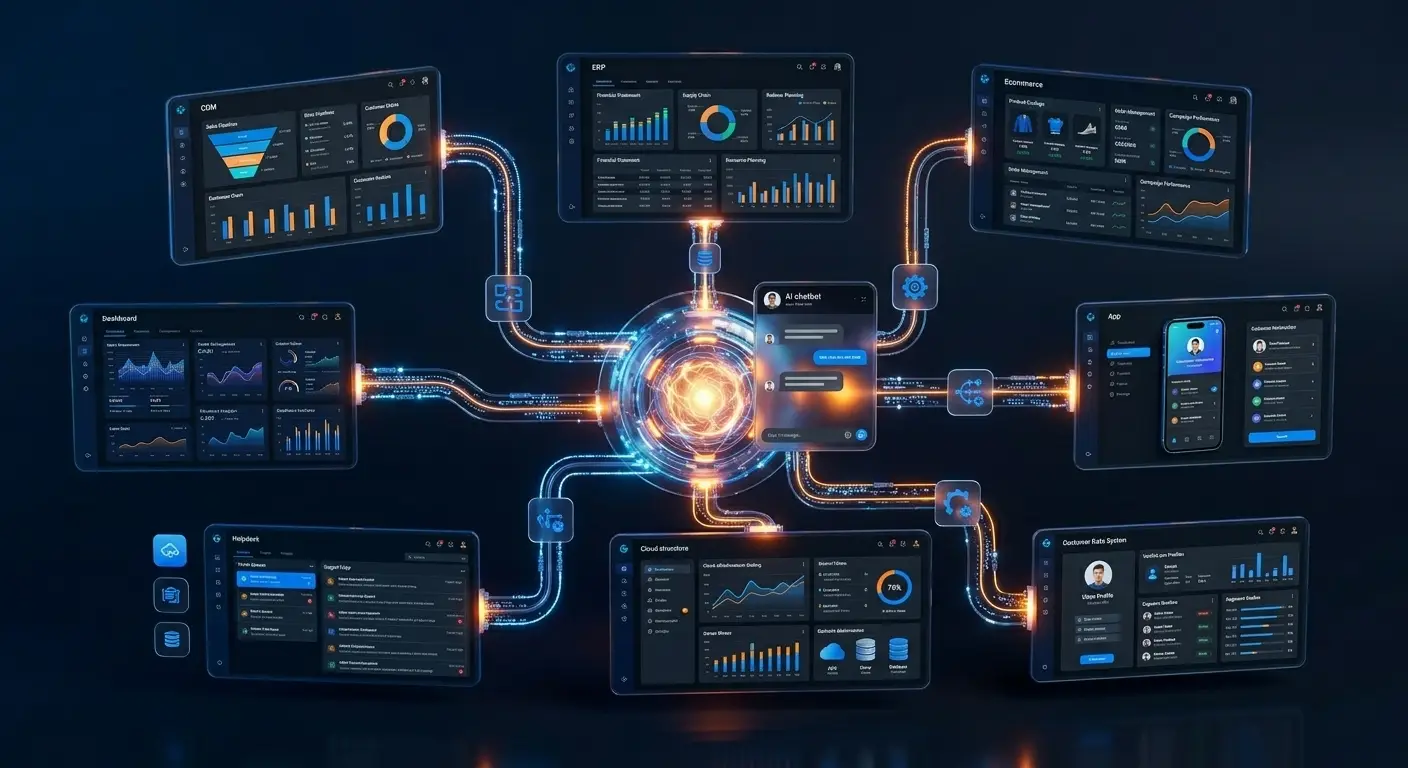
These systems integrate natively with your CRM, ERP, helpdesk, e-commerce platform, and internal databases. They do not just answer FAQs — they qualify leads, process refunds, book appointments, update records, escalate complex issues, and deliver personalized responses based on live customer data. According to IBM’s research on AI chatbots, businesses deploying AI-powered virtual assistants report significant reductions in operational costs alongside improved customer satisfaction scores.
Why Every Business Needs a Custom AI Chatbot for Business Right Now
The demand for instant, intelligent, always-available support has never been higher. Consumers now expect responses within seconds — not hours. A custom AI chatbot for business addresses this expectation directly while simultaneously reducing the burden on human support teams.
Here are the core reasons why businesses across every sector are prioritizing custom AI chatbot development in 2026:
- 24/7 Availability Without Overtime Costs: AI chatbots operate continuously without breaks, holidays, or shift changes. Every inquiry receives an immediate response regardless of the time zone.
- Personalized at Scale: Unlike generic bots, a custom AI chatbot for business uses your actual customer data to deliver contextual, personalized conversations that feel human.
- Seamless System Integration: Custom-built solutions connect directly to your existing CRM, inventory systems, payment gateways, and analytics platforms — something no off-the-shelf tool can replicate.
- Consistent Brand Voice: Every response reflects your brand tone, terminology, and communication standards — trained specifically on your content and guidelines.
- Scalability During Peak Demand: Whether you have 10 or 10,000 simultaneous conversations, a custom AI chatbot handles the volume without degradation in quality.
Businesses looking to understand the broader ecosystem of intelligent automation should also explore AI automation for businesses to see how chatbots fit into a larger digital transformation strategy.
Key Benefits of a Custom AI Chatbot for Business
1. Dramatic Reduction in Support Costs
Human support agents are expensive. Salaries, training, management overhead, and attrition create a constant financial drain. A well-deployed custom AI chatbot for business can resolve 60–80% of incoming queries without any human involvement. The agents who remain focus exclusively on high-complexity, high-value interactions — dramatically improving their productivity and job satisfaction.
2. Higher Lead Conversion Rates
A custom AI chatbot for business does not just support — it sells. By qualifying website visitors in real time, recommending relevant products or services, and guiding prospects through the sales funnel, AI chatbots directly contribute to revenue growth. Platforms like Salesforce document cases where AI-assisted chat increases lead conversion by a significant margin compared to static contact forms.
3. Enterprise-Grade Data and Analytics
Every conversation a custom AI chatbot for business conducts generates structured data. This data reveals customer pain points, frequently asked questions, product confusion, and emerging trends — all in real time. Business intelligence derived from chatbot analytics directly informs product development, marketing strategy, and customer experience improvements.
4. Omnichannel Presence
A custom-built chatbot can be deployed simultaneously across your website, mobile app, WhatsApp, Facebook Messenger, Instagram DMs, Slack, and Microsoft Teams. This omnichannel capability means customers interact with your brand on their preferred platform — without you staffing each channel separately.
5. Faster Employee Onboarding and Internal Support
Custom AI chatbots are not limited to customer-facing use cases. Enterprises deploy them internally to handle HR queries, IT helpdesk tickets, policy lookups, and training material delivery. New employees get instant answers without interrupting senior staff — accelerating onboarding timelines significantly.

Comparing Generic Chatbots vs. Custom AI Chatbot for Business
| Feature | Generic/Off-the-Shelf Chatbot | Custom AI Chatbot for Business |
|---|---|---|
| Response Intelligence | Rule-based scripts only | NLP + context-aware reasoning |
| Brand Alignment | Generic tone, no customization | Trained on your brand voice and content |
| System Integration | Limited or no native integrations | Full API integration with CRM, ERP, helpdesk |
| Personalization | None — same response for everyone | Personalized by customer data and history |
| Scalability | Limited concurrent conversations | Cloud-native, unlimited scalability |
| Analytics | Basic conversation logs | Deep business intelligence and reporting |
| Security and Compliance | Shared infrastructure, generic policies | Dedicated, compliant infrastructure (GDPR, HIPAA) |
| Long-Term Cost | Monthly SaaS fees with limited ROI | Higher upfront, significantly lower cost per query |
Real-World Use Cases: Custom AI Chatbot for Business Across Industries
E-Commerce and Retail
Retailers deploy custom AI chatbots to handle order tracking, return processing, product recommendations, size guides, and promotional queries. The AI-powered customer support chatbot reduces cart abandonment by engaging hesitant shoppers with real-time answers — without requiring a live agent on standby.
Financial Services and Banking
Banks and fintech companies use enterprise AI chatbot solutions to handle account balance inquiries, transaction disputes, loan eligibility checks, and fraud alerts. Because these are custom-built, they operate within strict regulatory frameworks — something a generic tool cannot guarantee.
Healthcare and Telehealth
Healthcare providers deploy HIPAA-compliant AI chatbots for appointment scheduling, symptom checking, prescription refill requests, and patient intake forms. The chatbot integrates directly with electronic health record (EHR) systems — a capability that requires fully custom development.
SaaS and Technology Companies
SaaS platforms use custom AI chatbots for in-app user onboarding, feature discovery, technical support, and churn prevention. When a user shows signs of disengagement, the chatbot proactively surfaces relevant resources or connects them with a success manager — turning passive churn signals into active retention opportunities.
Real Estate
Property management companies and agencies deploy conversational AI for business automation to handle property inquiries, schedule viewings, collect lead qualification data, and answer financing questions — 24 hours a day, across multiple languages.
Challenges in AI Chatbot Development Services — and How to Solve Them
Deploying a custom AI chatbot for business is not without complexity. Understanding the challenges upfront prevents costly mistakes during development and post-launch.
Challenge 1: Data Quality and Training
Problem: An AI chatbot is only as good as the data it is trained on. Incomplete, inconsistent, or outdated training data produces poor responses that damage customer trust.
Solution: Begin with a thorough audit of your existing knowledge base, support tickets, product documentation, and FAQ archives. Structure and clean this data before training begins. Implement a continuous feedback loop that improves the model over time based on real conversations.
Challenge 2: Integration Complexity
Problem: Connecting a chatbot to legacy CRM systems, proprietary databases, or complex ERP platforms often requires significant API development work.
Solution: Partner with an experienced AI chatbot development services provider who conducts a thorough technical audit before development begins. Proper API architecture and middleware design eliminate most integration failures.
Challenge 3: Maintaining Accuracy Over Time
Problem: Products change, policies evolve, and new services launch. A chatbot trained on old data will give incorrect answers — eroding user confidence rapidly.
Solution: Implement a content management layer that allows non-technical staff to update chatbot knowledge without requiring developer involvement. Schedule regular model reviews and retraining cycles — quarterly at minimum.
Challenge 4: Handling Edge Cases and Escalation
Problem: No AI chatbot handles every situation perfectly. Mishandled edge cases — especially in high-stakes interactions like billing disputes or medical queries — can create serious problems.
Solution: Design a graceful human escalation protocol into the chatbot’s core logic from day one. The chatbot should detect frustration, complexity thresholds, and sensitive topics — and seamlessly hand off to a human agent with full conversation context transferred.
Future Trends: Where Custom AI Chatbot for Business Is Heading
The capabilities of enterprise AI chatbot solutions are evolving at a pace that few anticipated even two years ago. Businesses building custom AI chatbots today are laying the foundation for capabilities that will be standard within 18 months.
- Multimodal AI Chatbots: Future chatbots will accept and respond to images, voice, and video — not just text. A customer can photograph a damaged product and the AI will process a return instantly.
- Agentic AI Capabilities: As highlighted by OpenAI’s research on agentic systems, the next generation of AI chatbots will autonomously complete multi-step tasks — browsing internal systems, filling forms, and executing transactions without human confirmation for low-risk actions.
- Emotion Recognition and Sentiment Steering: Advanced models will detect emotional states from text and adapt their communication style in real time — becoming more empathetic during a complaint, more celebratory during a successful purchase.
- Hyper-Personalization Through Real-Time Data: Chatbots will pull from live behavioral data, purchase history, and browsing patterns to make highly relevant, timely offers during the conversation itself.
- Voice-First Conversational AI: As voice interfaces mature, custom AI chatbots will operate natively in voice format — both for customer-facing IVR replacement and internal voice-activated enterprise tools.
For businesses exploring how AI is transforming their entire digital stack, our guide on AI chatbot development covers the technical and strategic foundations in detail.
Best Practices for Deploying a Custom AI Chatbot for Business
- Define Clear Objectives First: Identify the specific business outcomes you want — cost reduction, lead generation, NPS improvement. Vague goals produce vague results.
- Map the Customer Journey: Understand every touchpoint where a customer interacts with your business. Deploy the chatbot at the highest-friction, highest-volume points first.
- Invest in Quality Training Data: Allocate budget and time for proper data curation. This is not where to cut corners — it directly determines chatbot intelligence.
- Build Human Escalation In From Day One: Never deploy a chatbot without a clear, tested escalation path to a human agent for complex or sensitive situations.
- Test With Real Users Before Full Launch: Run a closed beta with a subset of actual customers. Their interactions will reveal gaps that internal testing always misses.
- Monitor KPIs Continuously: Track resolution rate, escalation rate, CSAT score, conversation length, and conversion rate. Use this data to drive ongoing improvement cycles.
- Communicate AI Transparency: Be transparent with customers that they are interacting with an AI. Modern consumers respect honesty — and Google’s guidelines on conversational AI reinforce the importance of transparency in automated interactions.
- Plan for Multilingual Support: If your business serves international customers, build multilingual capability into the initial scope. Retrofitting language support later is significantly more complex.
Businesses already leveraging AI-powered tools should also consider reading about enterprise AI solutions to understand how chatbots integrate into the broader intelligent enterprise architecture.
How to Choose the Right AI Chatbot Development Services Partner
Selecting a development partner is arguably the most consequential decision in this process. The right partner does not just build you a chatbot — they architect a long-term AI asset that evolves with your business. Evaluate potential partners on these criteria:
- Demonstrated AI and NLP expertise — not just no-code chatbot builders
- Experience with your industry-specific compliance requirements (GDPR, HIPAA, PCI-DSS)
- Proven integration track record with your existing technology stack
- Transparent methodology — clearly defined discovery, design, development, and testing phases
- Post-launch support and model maintenance as a core offering — not an afterthought
- Measurement and reporting framework — they should be as focused on your business outcomes as you are
According to Gartner’s research on conversational AI, organizations that align their chatbot strategy with clear business outcomes see substantially higher satisfaction and ROI than those that deploy chatbots as standalone technical experiments.
Frequently Asked Questions: Custom AI Chatbot for Business
What is a custom AI chatbot for business, and how is it different from a regular chatbot?
A custom AI chatbot for business is purpose-built using artificial intelligence — specifically NLP and machine learning — tailored to your company’s specific data, workflows, and customer interactions. Unlike generic chatbots that follow fixed scripts, a custom AI chatbot understands context, learns from conversations, and integrates with your CRM, helpdesk, and other business systems to deliver intelligent, personalized responses.
How much does it cost to build a custom AI chatbot for business?
Custom AI chatbot development costs vary significantly based on complexity, integrations required, and the sophistication of AI capabilities. Simple AI chatbots may start from a few thousand dollars, while enterprise-grade solutions with full system integration, multilingual support, and advanced analytics can range considerably higher. The ROI — measured in support cost reduction, lead conversion improvement, and operational efficiency — typically justifies the investment within 6–12 months for most businesses.
Can a custom AI chatbot integrate with my existing CRM and helpdesk?
Yes. One of the primary advantages of a custom AI chatbot over off-the-shelf tools is its ability to integrate directly with your existing technology stack via APIs. Salesforce, HubSpot, Zendesk, Freshdesk, SAP, and most major CRM and ERP platforms offer API access that a custom chatbot can leverage to read and write customer data in real time.
How long does it take to develop and deploy an enterprise AI chatbot solution?
Development timelines depend on scope and complexity. A focused AI chatbot for a specific use case — such as lead qualification or support triage — can be deployed in 6–10 weeks. Full enterprise AI chatbot solutions with deep system integration, multi-channel deployment, and extensive training datasets typically require 3–6 months from discovery to launch.
Is a custom AI chatbot suitable for small and medium-sized businesses?
Absolutely. While enterprise companies benefit enormously from custom AI chatbots, SMBs see proportionally high impact because even a modest improvement in support efficiency or lead conversion creates significant relative gains. Many AI chatbot development services providers offer scalable packages designed specifically for SMB budgets and growth trajectories.
Conclusion: Your Custom AI Chatbot for Business Strategy Starts Today
The competitive window for deploying a custom AI chatbot for business is narrowing. Businesses that invest now build a meaningful advantage — in customer experience, operational efficiency, and data intelligence — that compounds over time. Those that delay will spend the next two years playing catch-up against competitors who have already optimized their AI chatbot performance through real-world iteration.
A custom AI chatbot for business is not a technology experiment. It is a strategic infrastructure investment that touches sales, support, marketing, and operations simultaneously. The question is no longer whether your business needs one — it is how quickly you can deploy one and how well you execute the strategy behind it.
If you are ready to explore what a custom AI chatbot for business could look like for your organization, the team at Axcel World specializes in end-to-end AI chatbot development services — from strategy and design through to integration, deployment, and ongoing optimization. Let’s build something that works as hard as you do.