Introduction: Why AI Agents for Customer Support Are No Longer Optional
Customer expectations in 2026 are brutal. Instant responses, accurate answers, 24/7 availability, zero repetition — these are now baseline demands, not competitive differentiators. Traditional support models built on large agent pools and rigid helpdesk workflows are buckling under the pressure. That is exactly why AI Agents for Customer Support have moved from innovation pilot to enterprise standard in under three years.
This guide breaks down what AI agents actually are, why forward-looking businesses are deploying them at scale, and precisely how you can implement AI automation for businesses to transform your customer experience operations in measurable, sustainable ways.
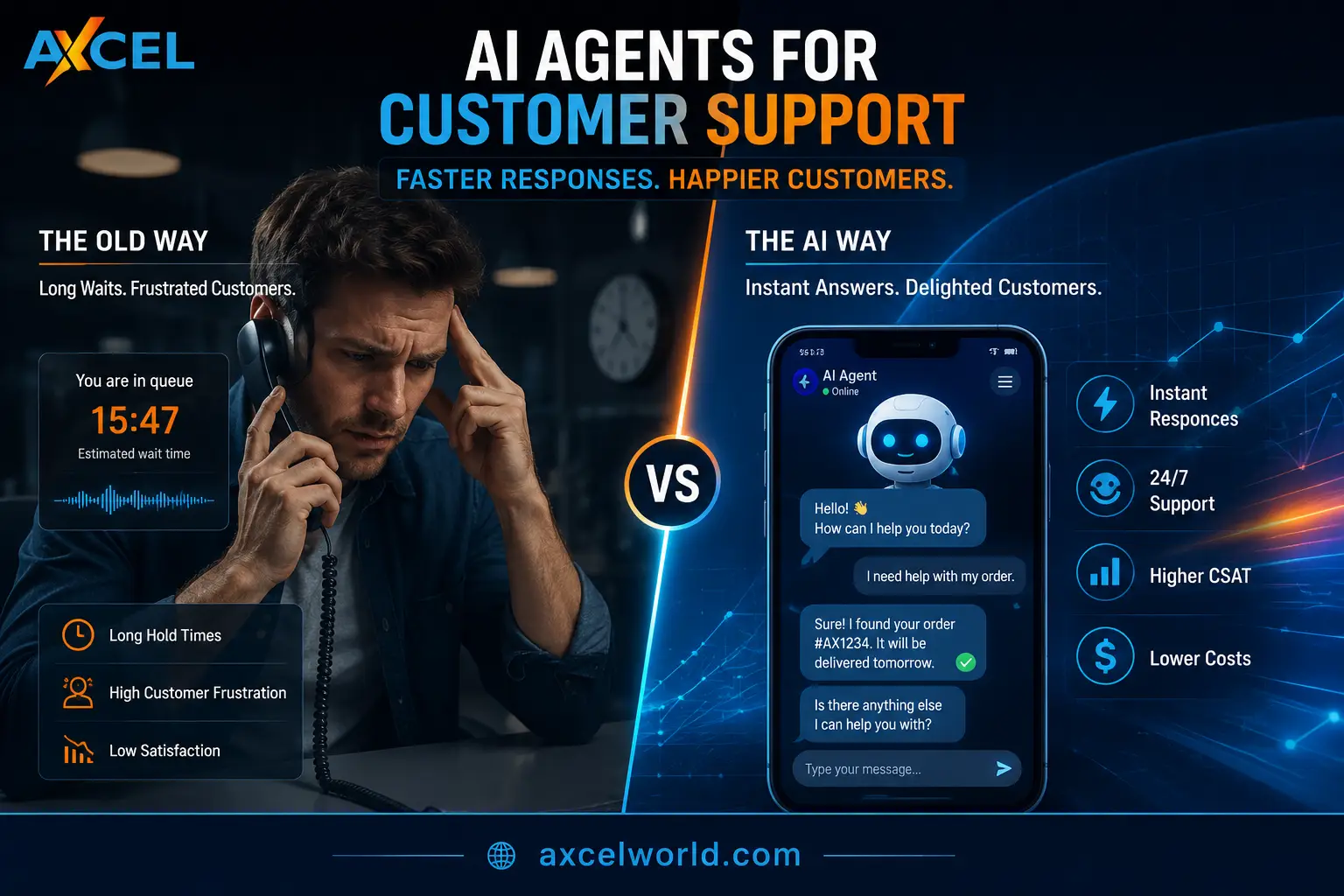
Whether you run a SaaS startup handling thousands of support tickets daily, a mid-market enterprise managing multi-channel customer queries, or a digital transformation initiative spanning multiple business units, the strategic case for AI Agents for Customer Support is now backed by hard operational data — not hype.
What Are AI Agents for Customer Support?
AI Agents for Customer Support are autonomous software systems that combine large language models (LLMs), natural language processing (NLP), retrieval-augmented generation (RAG), and enterprise workflow orchestration to understand, reason about, and resolve customer inquiries — with minimal or zero human involvement for qualifying interactions.
Unlike the rule-based chatbots of the early 2010s, which could only match keywords to scripted responses, modern AI agents reason contextually. They understand intent, retain conversation memory, access live business data through APIs, execute multi-step processes, and escalate complex cases to human specialists with full context intact.
Core Technical Components of an AI Support Agent
- Natural Language Understanding (NLU): Interprets customer intent, tone, urgency, and context across text, voice, and email channels.
- Retrieval-Augmented Generation (RAG): Grounds AI responses in verified internal knowledge bases, documentation, and CRM data — reducing hallucinations dramatically.
- Workflow Orchestration Engine: Executes real business actions — initiating refunds, updating account records, scheduling appointments, creating tickets — through API integrations.
- Conversation Memory and Context Management: Maintains session-level and cross-session awareness, eliminating the need for customers to repeat themselves.
- Intelligent Escalation Logic: Routes cases to human agents at the right moment, with full interaction history, sentiment analysis, and suggested next steps pre-loaded.
- Continuous Learning Loops: Improves resolution accuracy over time using reinforcement learning from human feedback (RLHF) and interaction outcome data.
According to IBM’s research on conversational AI, organizations that deploy AI-driven support agents achieve first-contact resolution rates between 65% and 85%, compared to 30–40% for legacy rule-based bots. The gap is structural, not marginal.
Why Businesses Need AI Agents for Customer Support Right Now
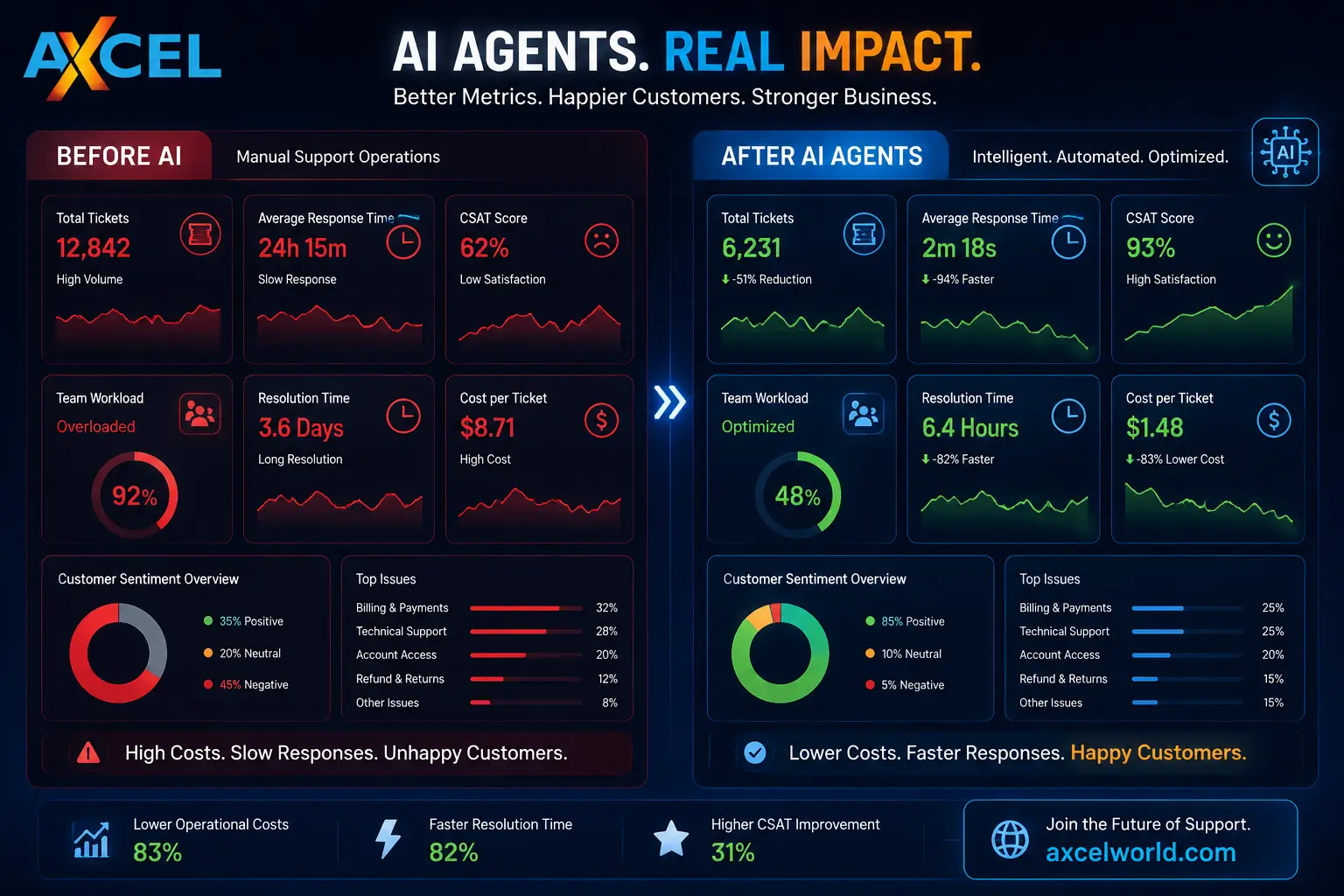
The structural pressure on customer support operations is not cyclical — it is permanent. Five irreversible forces are driving enterprise adoption of AI-powered customer service automation in 2026:
- Exponentially growing ticket volumes: Digital-first product growth has created support demand that scales faster than hiring can accommodate. AI is the only economically viable solution at scale.
- Shrinking customer patience: Average acceptable response time has dropped below 60 seconds for live chat. Human-only teams cannot sustain this expectation during peak demand periods.
- Multichannel complexity: Customers now contact businesses across chat, email, voice, SMS, social DMs, and in-app messaging — simultaneously. Managing consistency across all channels without automation is operationally impossible.
- Agent burnout and attrition: High-volume repetitive interactions are the primary driver of support agent burnout. Industry attrition rates in contact centers routinely exceed 30–40% annually, creating constant training overhead.
- Competitive differentiation through CX: According to Salesforce’s State of Service Report, 88% of customers say the experience a company provides matters as much as its products. CX is now a revenue driver, not a cost center.
Businesses deploying conversational AI in enterprise support operations are not just reducing costs — they are converting support from a liability into a measurable growth lever through retention improvements, upsell identification, and proactive issue resolution.
For a deeper look at enterprise-wide automation strategy, explore our guide on AI-powered digital transformation across business operations.
Key Benefits of AI Agents for Customer Support
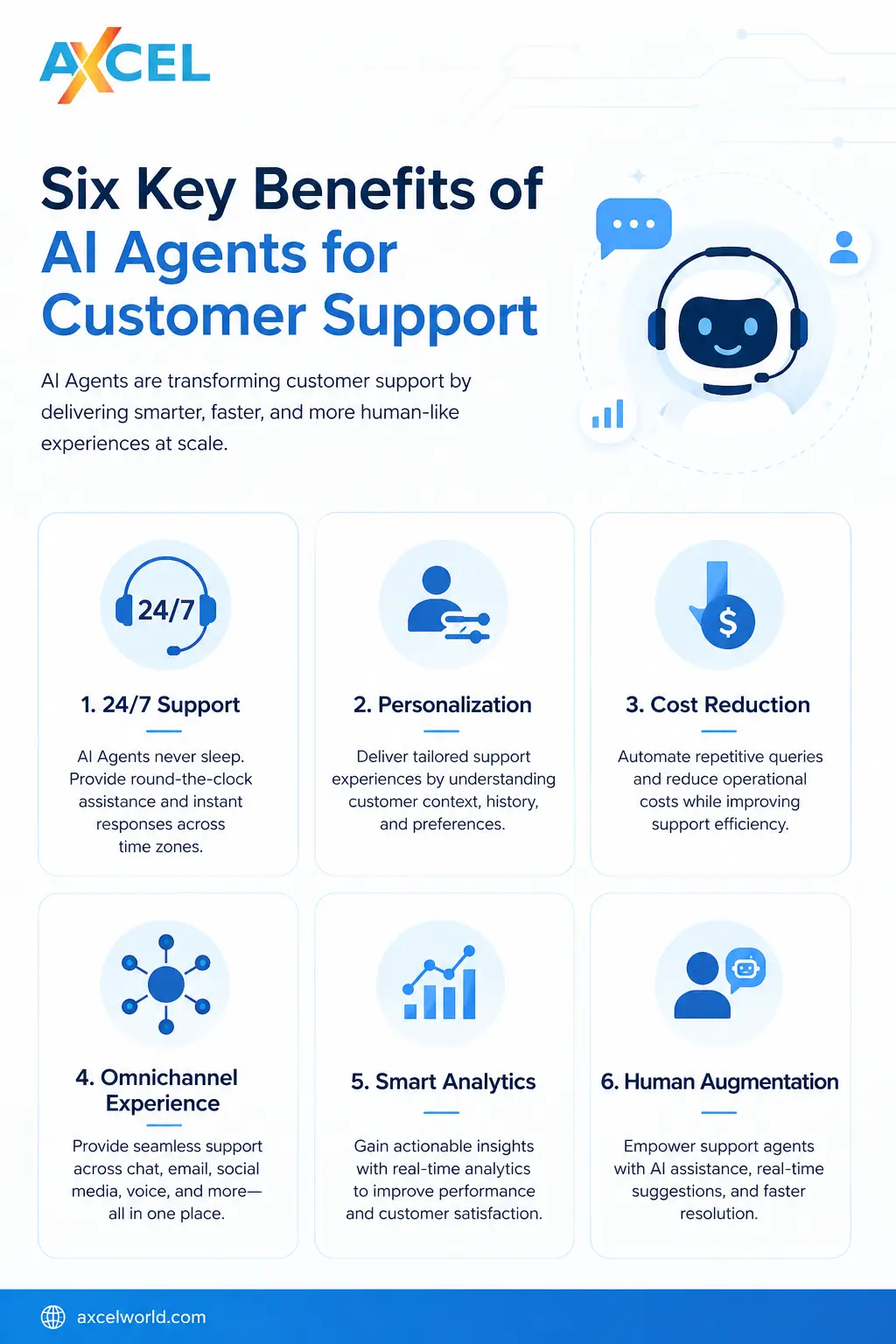
1. Always-On Availability at Enterprise Scale
AI agents operate 24 hours a day, 365 days a year, across all time zones — without fatigue, sick days, or shift gaps. During peak demand periods — product launches, seasonal surges, service outages — AI agents absorb volume spikes that would overwhelm even the largest human teams. This alone justifies deployment for any business with global customers or after-hours demand.
2. Hyper-Personalized Customer Experiences
Modern AI agents pull real-time data from CRM systems, purchase histories, behavioral analytics, and account records to tailor every interaction. Customers receive responses that acknowledge their specific account status, prior issues, product usage, and predicted needs. This level of personalization — at scale — is structurally impossible with human-only teams and is a primary driver of CSAT and NPS improvement.
3. Dramatic Cost Reduction Per Resolution
Enterprises deploying automated customer support solutions consistently report 40–60% reductions in cost per resolved ticket. This is achieved through autonomous handling of qualifying interactions, reduced average handle time on escalated cases (due to AI pre-processing), and significant reductions in agent headcount requirements for equivalent service volumes.
4. Omnichannel Consistency
AI agents deliver the same quality, accuracy, and brand voice across every customer touchpoint — chat, email, voice, mobile app, and social messaging — simultaneously. Context follows the customer across channel switches, eliminating the “please repeat your issue” experience that drives customer frustration and churn.
5. Operational Intelligence and Proactive Support
Every AI interaction generates structured data: intent categories, resolution outcomes, sentiment trends, escalation triggers, and emerging issue patterns. Support leaders gain real-time business intelligence that enables proactive improvements to product, policy, and process — often identifying systemic issues before they reach critical volume.
6. Agent Augmentation and Reduced Burnout
The most effective deployments position AI as an augmentation layer rather than a replacement. AI handles high-volume, low-complexity tickets autonomously. Human agents focus on emotionally complex, high-value, or technically sophisticated cases. This division dramatically reduces agent burnout, improves job satisfaction, and decreases costly attrition — while improving resolution quality on escalated interactions.
Real-World Use Cases: AI Agents for Customer Support Across Industries
eCommerce and Retail
A global eCommerce operation handling millions of monthly orders deployed AI agents to manage order tracking, return authorizations, refund processing, and product recommendations. Within six months, 74% of support tickets were resolved autonomously, CSAT improved by 19 points, and human agents shifted entirely to high-value escalations and complex dispute resolution. The ROI was realized within the first quarter of full deployment.
Banking and Financial Services
Banks and credit institutions are deploying AI agents — connected directly to core banking APIs — to handle account balance queries, fraud alert follow-ups, loan application status checks, and card management requests. The agents operate within strict security and regulatory compliance frameworks, providing secure, accurate responses in seconds while maintaining full audit trails required under financial regulations.
SaaS and Technology Companies
SaaS platforms use intelligent virtual agents for business to manage onboarding walkthroughs, troubleshooting guides, subscription and billing management, and feature education — reducing time-to-value for new users and cutting support ticket volume by up to 50% within the first 90 days of deployment. To understand how this fits within a broader software strategy, read our overview of AI tools for business growth in 2026.
Healthcare and Clinical Services
Healthcare providers deploy AI agents for appointment scheduling, prescription refill reminders, insurance inquiry handling, and symptom pre-triage — all within HIPAA-compliant architectures. AI agents reduce administrative burden on clinical staff, improve patient accessibility, and decrease no-show rates through intelligent reminder and rescheduling workflows.
The most common failure mode in AI support deployments is not technical — it is organizational. Teams that engage their human agents as partners in the design process achieve significantly higher adoption rates and better long-term outcomes than those that treat AI rollout as a pure technology project.
Gartner’s enterprise technology research consistently identifies change management as the top differentiator between AI deployments that scale successfully and those that plateau at pilot stage.
Future Trends: What’s Next for AI Agents for Customer Support
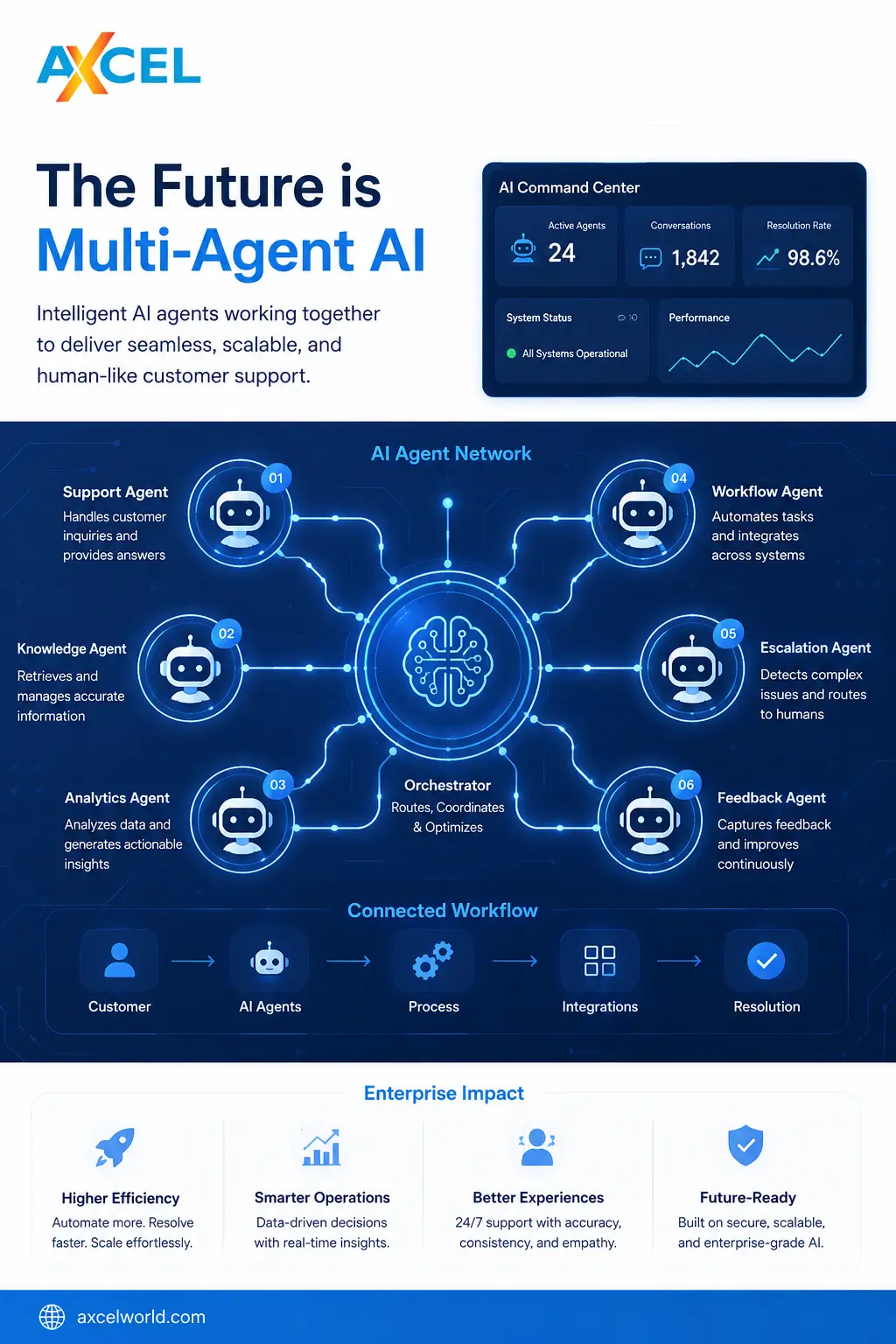
The capabilities of AI Agents for Customer Support are advancing at a pace that makes 12-month-old deployments feel outdated. Here are the six trends that will define enterprise AI support strategy through 2027:
- Agentic AI and Multi-Agent Orchestration: Rather than a single generalist agent, enterprise systems will deploy networks of specialized agents — a routing agent, a knowledge retrieval agent, a resolution agent, a quality assurance agent — collaborating in real time to handle complex, multi-domain customer issues. OpenAI and other leading AI providers are actively developing agentic frameworks specifically designed for enterprise workflow orchestration.
- Voice AI and Multimodal Agents: Next-generation agents will move fluidly between text, voice, and image understanding within a single customer interaction — enabling visual troubleshooting, real-time document analysis, and natural spoken conversation as standard capabilities.
- Proactive and Predictive Support: AI agents will identify and resolve customer issues before they are reported — triggered by behavioral signals, product usage anomalies, payment failure predictions, or system monitoring alerts. Support shifts from reactive to genuinely preventive.
- Emotion-Aware AI Interactions: Advanced real-time sentiment analysis will enable agents to detect frustration, confusion, or urgency and dynamically adjust communication tone, escalation thresholds, and response pacing — making AI interactions feel more responsive and human without requiring actual human intervention.
- Fully Autonomous End-to-End Resolution: AI agents capable of completing complex, multi-system workflows entirely autonomously — identifying a billing discrepancy, cross-referencing the subscription record, initiating a credit, updating the CRM, and sending a confirmation — without any human review step for qualifying transaction types.
- Industry-Specific AI Agent Platforms: Pre-trained, vertically specialized AI agents — built for healthcare, financial services, logistics, or SaaS — available as plug-and-play enterprise solutions. This will dramatically compress deployment timelines and reduce custom development requirements for most businesses.
For context on how these developments fit within broader enterprise AI strategy, see our in-depth look at generative AI in enterprise solutions.
Best Practices for Implementing AI Agents for Customer Support
Successful deployment of AI Agents for Customer Support is a strategic initiative — not a technology installation. These are the eight practices that consistently separate high-performing deployments from stalled pilots:
- Start Focused, Not Broad: Begin with your highest-volume, lowest-complexity use cases — FAQs, order status, password resets, appointment scheduling. Build confidence, collect real interaction data, and expand scope based on measured outcomes. Broad Day-1 deployments rarely succeed.
- Invest in Knowledge Architecture First: Your AI is only as accurate as the knowledge it draws from. Before deployment, audit, clean, and structure your internal knowledge base. Establish ownership and maintenance workflows for ongoing updates. This single investment has the highest leverage of any pre-deployment activity.
- Design Escalation as a Feature, Not a Fallback: The handoff from AI to human should be seamless, context-rich, and branded as a positive service experience — not an admission of failure. Design escalation paths as carefully as your core AI conversation flows. Explore how AI integration for modern enterprises enables smooth human-AI collaboration at scale.
- Measure Outcomes, Not Just Activity: Track first-contact resolution rate, containment rate (% of issues resolved without escalation), CSAT specifically on AI-handled interactions, escalation rate, and average handle time. These five metrics give you an accurate operational picture. Volume metrics alone are misleading.
- Align AI with Your Brand Voice: Generic, robotic AI responses damage brand equity. Train your AI to speak in your organization’s specific tone, use your product terminology, and reflect your service values. This requires intentional conversation design — not just LLM deployment.
- Enforce Security and Compliance by Design: Ensure your AI architecture complies with GDPR, CCPA, HIPAA, or applicable industry frameworks from day one. Retroactively adding compliance to AI systems is costly and disruptive. Build it into your selection criteria and deployment design. AWS’s enterprise compliance frameworks provide a useful reference for cloud-based AI deployments.
- Run Structured A/B Testing Continuously: Test variations in response phrasing, escalation trigger logic, conversation opening sequences, and knowledge retrieval configurations. Even small improvements in resolution rate compound significantly at enterprise scale. Treat your AI support system as a product that requires ongoing development, not a set-and-forget installation.
- Involve Your Human Support Team Throughout: Your existing agents possess irreplaceable institutional knowledge about customer edge cases, product quirks, and escalation nuances. Engage them as active co-designers of the AI system — not as passive observers of a technology rollout. Their input will prevent a significant proportion of deployment failures.
Frequently Asked Questions About AI Agents for Customer Support
What are AI Agents for Customer Support?
AI Agents for Customer Support are autonomous software systems that use large language models, natural language processing, and workflow automation to understand and resolve customer inquiries without requiring human involvement for every interaction. They connect to business systems through APIs, maintain conversation context, execute multi-step processes, and escalate complex cases to human agents with full context transferred.
How do AI agents differ from traditional chatbots?
Traditional chatbots follow rigid, predefined scripts and respond only to specific keyword triggers. AI agents use LLM-based reasoning to understand intent in natural language, maintain conversation memory across multiple turns, integrate with live business data, and execute real workflows — such as initiating refunds or updating account records. AI agents achieve first-contact resolution rates of 65–85%, versus 30–40% for rule-based bots.
What is the ROI of deploying AI agents in customer support?
Enterprises deploying AI-powered customer service automation typically report 40–60% reductions in cost per resolved ticket, 20–35% improvement in CSAT scores, 50%+ reductions in average handle time, and significant decreases in agent attrition. ROI is generally realized within 6–12 months of full deployment, depending on use case complexity, integration depth, and organizational readiness.
Are AI agents safe for handling sensitive customer data?
Yes — when properly architected. Enterprise AI agent platforms support GDPR, CCPA, HIPAA, SOC 2, and PCI-DSS compliance through private cloud or on-premise deployment, end-to-end encryption, role-based access controls, and full audit logging. Compliance must be built into the architecture from the selection stage — not retrofitted after deployment.
How long does it take to deploy AI agents for customer support?
Deployment timelines range from 2–4 weeks for basic FAQ and routing agents on pre-built platforms, to 8–16 weeks for mid-complexity deployments with CRM and ticketing system integrations, to 3–6 months for full-scale enterprise rollouts with custom model training and omnichannel coverage. Starting with a focused pilot on two or three high-volume use cases consistently delivers the fastest time-to-value and the strongest foundation for scaling.
Conclusion: The Business Case for AI Agents for Customer Support Is Settled
The transformation of customer support through intelligent automation is not a future scenario — it is the current competitive reality for enterprise organizations across every major sector. AI Agents for Customer Support are delivering measurable, compounding business value: lower cost per resolution, higher first-contact resolution rates, improved CSAT and NPS, reduced agent attrition, and real-time operational intelligence that drives continuous improvement.
The businesses establishing durable advantages in customer experience today are those investing in AI Agents for Customer Support now — building the knowledge architecture, integration foundations, and organizational capabilities required to scale intelligent automation as the technology rapidly advances.
The strategic question for enterprise leaders in 2026 is not whether to deploy AI agents. It is how quickly you can move from pilot to full-scale operation — and whether your organization’s knowledge infrastructure, integration stack, and change management capability are ready to support that transition.
If you are ready to evaluate your options, explore our practical breakdown of the benefits of AI workflow automation for enterprise operations — or connect with the AXCEL team to discuss a deployment strategy tailored to your support organization.